The $12,000 Hospital Bill From My Mom’s Third UTI Exposed The Bathroom Mistake I’d Been Making For Months

January 22nd, 2026
|
I thought scrubbing her toilet every Saturday meant I was protecting her. Then a retired nurse asked how many times she used it before I came back — and my stomach dropped. — Sarah M. |
My Mom’s Third UTI in 11 Months Cost Nearly $12,000 — Then a Retired Nurse Asked One Bathroom Question I Couldn’t Answer
My name is Sarah. If you’re caring for an aging parent, this may feel painfully familiar.
Last October, my phone rang at 3:07 AM.
It was my dad.
“Your mom is in the ER again.”
I sat up so fast I barely understood what he said at first.
Again.
That word hit me harder than anything else.
It was my mother’s third UTI — urinary tract infection — in just 11 months.
The first one had seemed minor. A few days of discomfort. A short course of antibiotics. Her doctor told us it was common in older women, and I believed him.
The second one was worse. Different medication. More fatigue. Less appetite. She recovered, but not fully. She became slower after that one. More fragile. Like something in her had been knocked down a level.
But the third one scared me in a way I still can’t forget.
She had a fever. Chills. She was weak enough that Dad couldn’t get her safely to the car by himself.
And when I walked into the ER room, my mother looked right at me and asked where her daughter was.
I was standing three feet away from her.
The doctor said what we had heard before: “UTIs are common in seniors.”
But nothing about that night felt common.
Mom spent five days in the hospital. Between tests, IV antibiotics, medications, room charges, follow-up care, and everything insurance didn’t fully cover, the bills came close to $12,000.
But the money wasn’t the part that haunted me.
It was watching my once-independent mother lying in that bed, confused, weak, and scared.
I kept asking myself the same question over and over: Where is this infection really coming from?
The Question That Changed Everything
A few weeks later, I spoke with Linda, a retired geriatric nurse with 28 years of experience.
I expected her to ask what antibiotic Mom had been given. She didn’t.
I expected her to ask if Mom was drinking enough water. She didn’t start there either.
Instead, Linda asked me two questions.
“How many times a day does your mom use the bathroom?”
I thought for a second. “Eight to ten times,” I said. “Sometimes more. She gets up several times at night too.”
Then Linda asked: “And how often is her toilet actually deep-cleaned?”
I hated that question because I already knew the answer.
I drive 30 minutes each way to help care for my parents. Most weeks, I deep-clean the bathroom every Saturday. On a good week, I can make it over twice.
I scrub the toilet. The seat. Under the rim. Around the base. The floor near the toilet. I use gloves, disinfectant, paper towels, and a separate trash bag.
I thought I was doing what a good daughter was supposed to do.
Linda nodded gently.
“Sarah, you’re doing your best,” she said. “But your mom may be using that toilet 50 to 70 times a week. Cleaning once or twice a week still leaves days in between.”
Then she said the sentence I couldn’t stop thinking about:
“Antibiotics treat the infection. They don’t fix the environment where bacteria may keep building back up.”
That was the moment I realized I had been fighting the wrong battle.
I Was Cleaning on My Schedule. Mom Was Using the Bathroom on Hers.
I had been thinking about the toilet only on cleaning day.
Saturday morning: I clean it.
Then I leave.
Saturday afternoon, Mom uses it again. Saturday night. Sunday. Monday. Tuesday. Wednesday. Thursday. Friday.
By the next Saturday, that same toilet may have been used 50, 60, even 70 times.
And I wasn’t there for any of it.
That was the gap I had never thought about.
I was trying to solve a daily problem with a weekly routine.
Not because I didn’t care. Not because I wasn’t trying.
But because no human being can drive over and sanitize a toilet after every bathroom trip.
I could clean harder. I could buy stronger products. I could feel guilty every Saturday and still not close the gap between cleanings.
That was the part that made me feel sick.
Because for months, I had been telling myself: “At least I’m keeping the bathroom clean.”
But I wasn’t keeping up with how often it was being used.

The Part Nobody Talks About When You’re Caring for Aging Parents
If you’ve never had to clean your parent’s bathroom, this may sound uncomfortable.
If you have, you know exactly what I mean.
There’s a smell that shows up before anyone wants to talk about it.
Not always strong. Not always obvious. Just a faint ammonia smell near the toilet. A little stickiness around the base. A surface that never feels quite as fresh as it did right after you cleaned.
My mother never admitted anything was different.
“The bathroom is fine,” she would say.
So I stopped asking. I just cleaned.
And honestly, I felt awful about how much I dreaded it.
I love my mother. But there were Saturdays when I sat in my car for a minute before going inside because I knew what I was about to do.
I hated that I felt that way. I hated that I had become the secret bathroom cleaner.
I hated that after all of that effort, I still couldn’t be there during the other six days of the week.
That’s the part of caregiving nobody prepares you for.
You’re not just managing appointments and medications. You’re managing the quiet, private things your parent is too embarrassed to talk about.
Then Linda Told Me About a Small 2-in-1 Bathroom Device
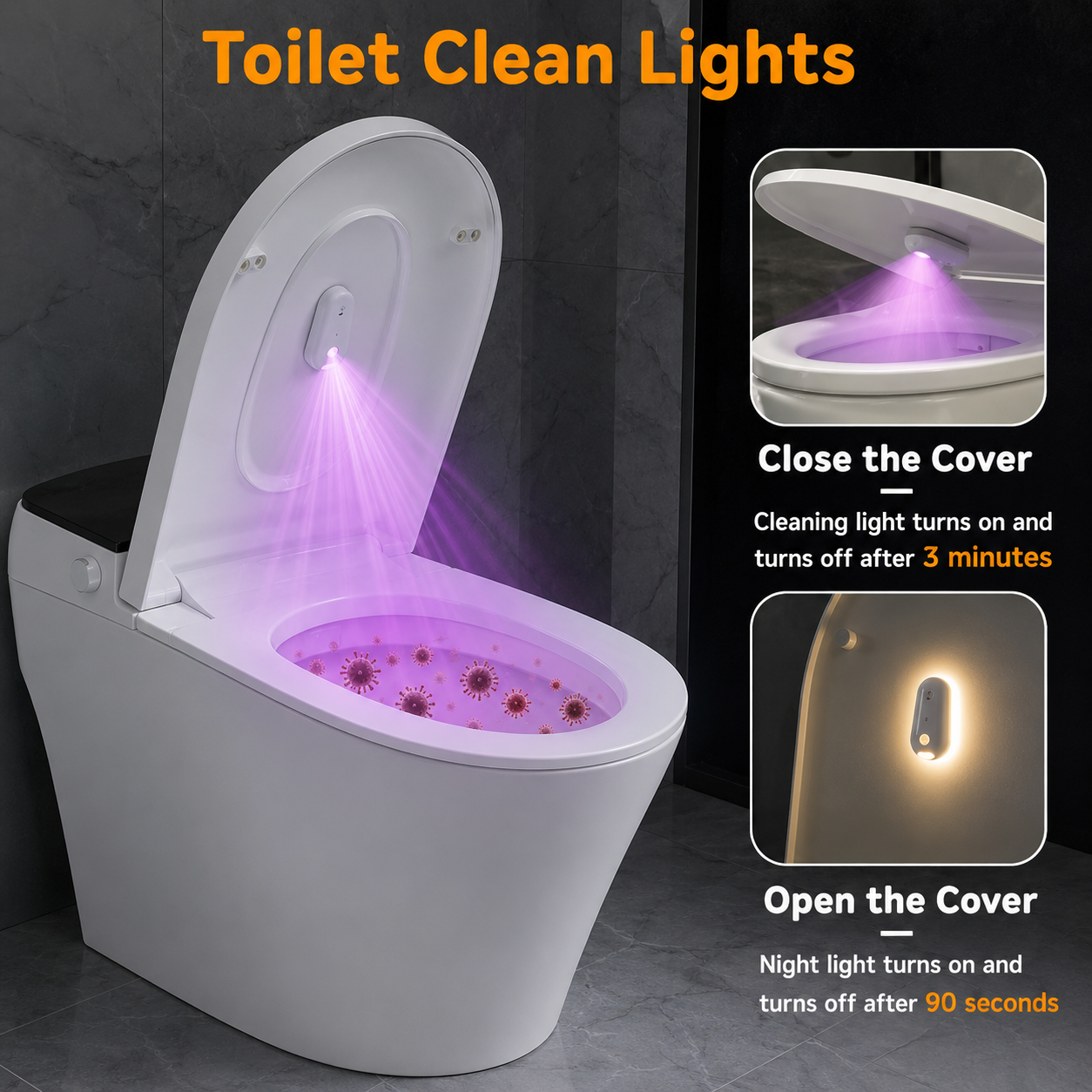
Linda told me about a type of device I had never seriously considered before: a UV-C Toilet Sanitizer & Night Light.
Not a spray. Not a toilet perfume. Not another cleaner I had to remember to bring.
A small device that attaches to the toilet and runs an automatic UV-C cycle after the lid closes.
The reason it caught my attention was simple:
Mom didn’t have to remember anything. She didn’t have to press a button. She didn’t have to spray the toilet. She didn’t have to wipe anything. She didn’t have to change her routine.
The lid closes. The cycle runs.
That was the missing piece for me.
Not deeper cleaning on Saturday. Not stronger disinfectant. Not me trying to become a 24/7 cleaning system.
Just something that could help support a cleaner toilet routine between the times I was actually there.

The Night Light Wasn’t Why I Bought It — But It Became the Feature Mom Loved First
The device also had a motion-sensor night light.
At first, I barely cared about that. I bought it because of the UV-C feature.
But then I thought about Mom’s nights.
She gets up around 1 or 2 AM. Then again around 3 or 4. Sometimes again before sunrise.
She refuses to turn on the overhead bathroom light because once that bright light hits her eyes, she says she’s awake for an hour.
So she walks to the bathroom in the dark.
She knows the hallway. She knows the sink. She knows where the toilet is.
But 79 is not 59.
Her vision isn’t the same. Her balance isn’t the same. Her reflexes aren’t the same.
I had brought up grab bars before. I had mentioned a shower chair. I had looked at better mats.
Every time, Mom pushed back.
“Don’t turn my bathroom into a hospital room,” she told me.
So I kept delaying those conversations.
This was different.
It didn’t look medical. It didn’t make her feel helpless.
It just gave her a soft light when she walked into the bathroom at night.
Not the harsh overhead light. Just enough to see the toilet, the floor, and the path back to bed.
I Ordered Two That Night
That night, at 11:47 PM, I ordered two.
One for Mom’s house.
One for the guest bathroom in my own home, because she usually stays with us on weekends.
When the package arrived, I brought it to her house on my next visit.
I still remember that morning clearly.
Mom was sitting at the kitchen table with her tea, like she always did. I set the box down gently, trying not to make it sound like I was bringing another “old person device” into her home.
“Mom, I got you this small toilet light,” I said. “It turns on by itself at night, and it has UV-C to help sanitize the toilet after the lid closes.”
She looked at the box for a few seconds.
“Is this another thing I have to use?”
I shook my head.
“No. You don’t have to do anything. I’ll attach it, and it runs automatically.”
I peeled the adhesive, mounted it near the toilet, checked the sensor, and plugged it in for the first charge.
It took less than a minute.
No drilling. No contractor. No bathroom renovation.
No argument like the ones we’d had when I mentioned grab bars or a shower chair.
Mom looked at it for a moment and said: “Well, that’s actually pretty small.”
That was the first time I exhaled.
The First Thing I Noticed Was the Smell
For the first week, I tried not to get my hopes up.
I still called too much. “Did it bother you?” “Did it turn on?” “Did it feel strange?”
Mom sounded almost annoyed.
“It’s fine,” she said. “The little light is nice.”
Then she told me something that stuck.
“I got up around two last night and didn’t have to turn on that awful ceiling light. I went right back to sleep.”
That alone made me feel better.
But I was still waiting for Saturday. That was my bathroom day.
I walked in with the same supplies I always brought: gloves, paper towels, disinfectant, trash bag.
I opened the bathroom door and braced for the smell.
Nothing.
Not perfume. Not bleach. Not a fake “fresh” scent.
Just nothing.
No sharp ammonia smell. No sticky feeling around the base. No film on the seat. No little signs that told me exactly how the week had gone.
The bathroom felt normal.
I still cleaned it. But that day, it took ten minutes. Like a normal bathroom. Not like a weekly emergency.
That’s when I understood what the device was really doing for me.
It wasn’t replacing me as a daughter.
It was helping with the one part I could never do: working between my visits.
I’m Not Saying It Replaces Doctors, Cleaning, or Medical Care
Let me be very clear.
This device does not replace doctors. It does not replace medical care. It does not replace regular bathroom cleaning. It does not mean you ignore symptoms of a urinary tract infection.
If your parent has symptoms, confusion, fever, pain, weakness, or sudden changes, you should contact a doctor.
But for the first time, I felt like we had addressed the part I had been missing.
I could only clean on my schedule.
Mom used the bathroom on hers.
And that gap mattered.
The Costs Made the Decision Easy
I couldn’t stop thinking about the numbers.
Nearly $12,000 for one hospital stay.
That doesn’t include the fear. The missed work. The follow-up appointments. The weight she lost. The way she looked at me in the ER and didn’t know who I was.
I had already started pricing other bathroom updates: better mats, grab bars, a raised seat, maybe a handyman, maybe a contractor.
Hundreds if we kept it simple. Thousands if we did everything properly.
And then there are the costs nobody wants to think about: a worse infection, a fall during a weak or confused night, rehab, assisted living, and the conversation every child hopes they never have to start.
Compared with all of that, a small device that installed in under a minute and worked automatically felt like one of the easiest decisions I had made all year.

What I Wish Someone Had Told Me Earlier
If your mom or dad has had recurring UTIs — urinary tract infections — please don’t only ask what medication they were given.
Ask what’s happening in the bathroom between cleanings.
If their bathroom has started to smell different, don’t ignore it.
If they use the toilet many times a day, count how often that surface is actually being cleaned.
If they refuse to turn on the overhead light at night, think about what that means at 2 or 3 AM.
I wish I had asked these questions earlier.
Not after the third ER visit. Not after another antibiotic. Not after another hospital bill. Not after weeks of blaming myself for not doing enough.
Because I was doing a lot.
I just wasn’t solving the right gap.
The Device I Installed
The device I installed is a UV-C Toilet Sanitizer & Night Light.
It attaches directly to the toilet.
After the lid closes, it runs an automatic UV-C cycle designed to help sanitize toilet surfaces between manual cleanings.
It also has a motion sensor that turns on a soft night light when someone enters the bathroom at night.
No harsh overhead light. No extra step for Mom to remember. No drilling. No tools. No turning the bathroom into a hospital room.
I bought one for Mom’s house and one for ours.
And if you’re caring for an aging parent, especially one who has had recurring UTIs or gets up at night to use the bathroom, this may be one of the simplest upgrades you can make to their daily routine.
You can’t be there after every bathroom trip.
This can run after every lid close.
And when they walk in at 2 or 3 AM, the soft light is already there.
Special Offer Right Now
· Buy One, Get One 50% Off
· Free Shipping
· 30-Day Money-Back Guarantee
If your mom or dad has had recurring UTIs, or if you worry about them getting up at night, this could be a small change that gives you real peace of mind.
I’ve cried in too many hospital parking lots after those 3 AM calls.
I don’t want you to go through the same thing before asking the question I wish I had asked sooner:
What’s happening in their bathroom between the times you’re there?
P.S.
If you’re telling yourself, “But I clean their bathroom every week,” I understand.
I told myself the same thing.
Ask one more question:
What happens during the days between my cleanings?
That question changed the way I looked at my mother’s entire bathroom.
Advertisement Disclosure: This is an advertisement. Results may vary. This product is not intended to diagnose, treat, cure, or prevent any disease. Always consult a licensed medical professional about urinary tract infections, senior safety, fall risk, or sudden changes in health.